Thursday, February 12, 2009

American HardCORR – Traxxas Slash

Categories - Cars, Products, Traxxas - trackback

Traxxas Slash

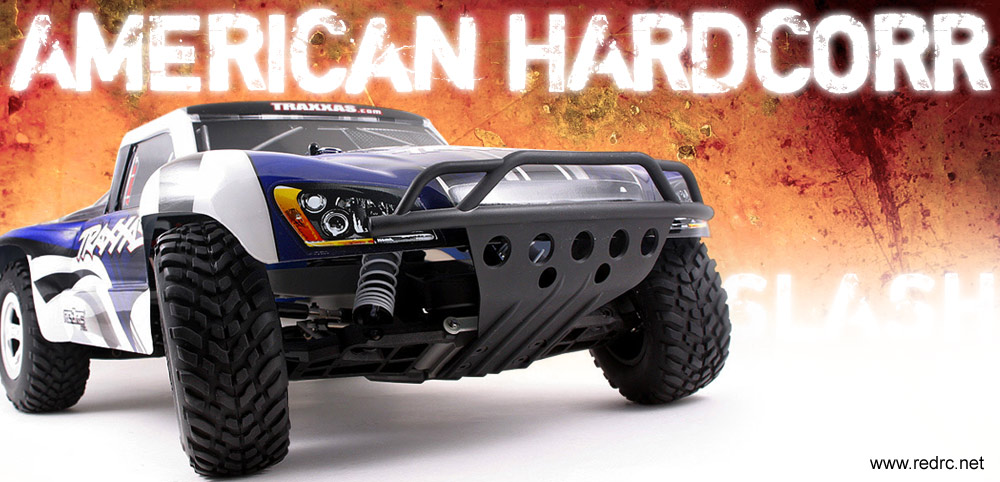
What started as what appeared to be “just another” racing class turns into a new hot trend as it seems: the four letters “CORR” (Championship Off Road Racing) take the RC-Car racing scene by storm and once again it was Traxxas that started it all. This time with the help of the Slash called 2WD racing truck. How will it perform in the European winter?
Traxxas Slash

The so called short course racing trucks may be nothing new to you if you live in the US and know the ‘stadium trucks’ for ages. All others may be aware that the CORR racing series is possibly the world’s only full scale racing class that seems inspired by RC-Cars – not the other way around. The most fascinating fact about CORR is that the series is run on often purpose built short tracks with huge jumps, banked corners and high speed straights that look like taken straight from your local RC track. Watching a CORR race has all, if not more, of the drama you can witness in off-road races all over the world: huge high-flying off-road action, door handle-to-door handle fights and breath-taking crashes. If you want to learn more about CORR racing action, check this video.

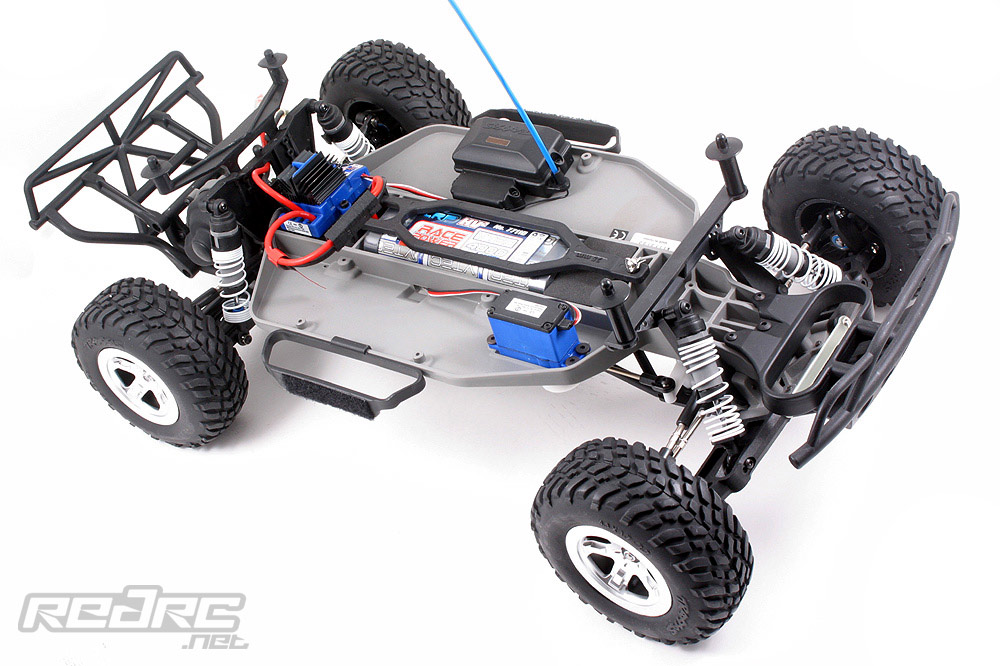
Back to the Traxxas Slash. It is a ‘semi’ replica of a full scale CORR Pro2 class truck. ‘Semi’ since not every feature of the real truck made its way into the scale model but the truck has more to offer than only a nice bodyshell inspired by the real Traxxas sponsored Jenkins Brothers Racing Team Pro2 truck.

Front
The most similarities between the two can be found up front. The Pro2 truck as well as the Traxxas Slash feature independent double wishbones which offers a wide track, huge ground clearance and loads of suspension travel. This is due to long lower wishbones and around 95mm long oil-filled shock absorbers. These feature full-plastic housings and progressive springs. The standard set-up also features 30wt oil. According to Steve Slayden’s Stock-Spec Racing Setup Guide on Traxxas’ website a change to 50wt oil helps smoothing the weight transfer side to side on high grip surfaces or when using the truck on a permanent race track.
Traxxas Slash

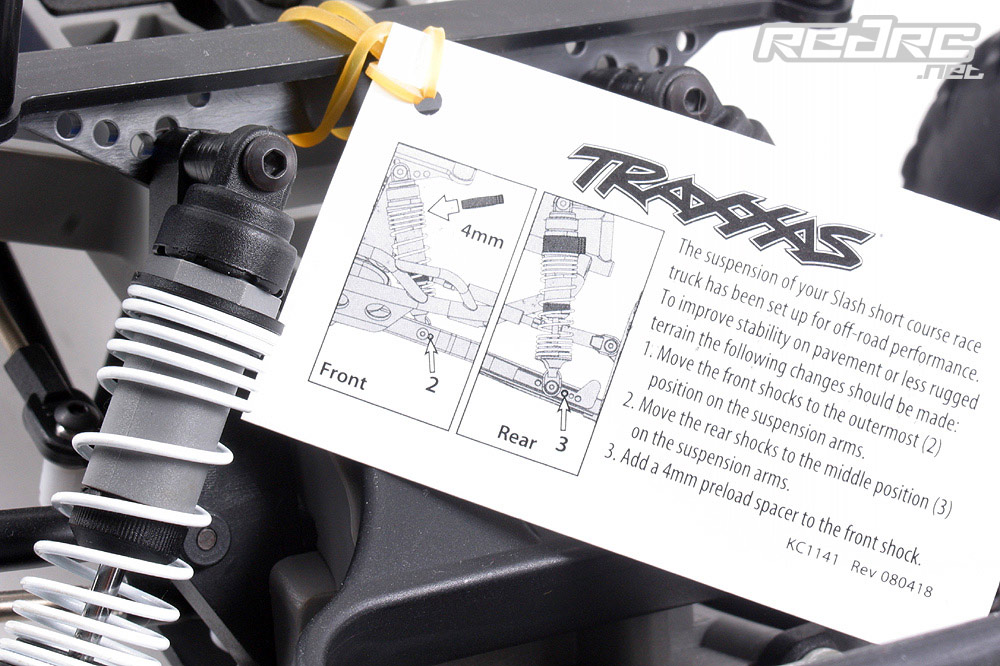
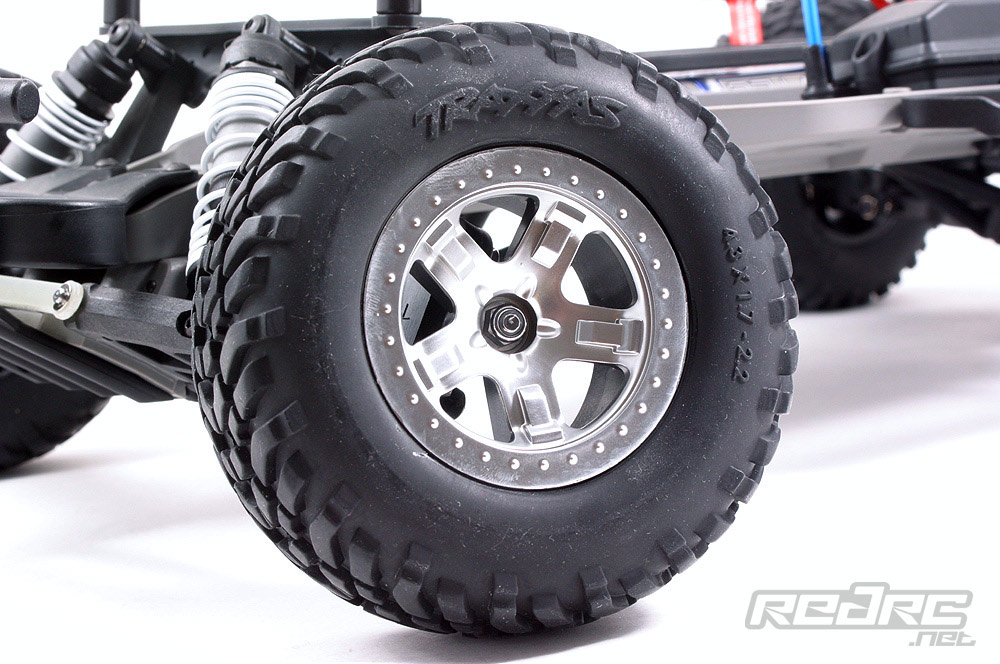
The wishbones are equipped with an optional hole for the shock mounting allowing the damping characteristics to be adjusted to suit both rough and smooth surfaces. The caster blocks are of a conventional C-hub style and allow for 30° of caster. Optional alloy ones for added strength and look are available as a Traxxas option part. The outer steering blocks house ball bearings with blue seals which should withstand the rigors of bashing and racing better than the usual steel backed ones. The outer points of the chassis are marked by the very nice bead-lock style rims with pre-glued block-pattern tyres.

The steering consists of a fixed double bell crank system with easy to adjust left/right turnbuckles to the steering blocks.

Traxxas Slash

Usage »

If you republish any elements from this page on another website, including text, original pictures or formatted results please be sure to add a link back to this page as the source.

Related Posts »

Comments »

1. The JANG - February 12th, 2009 at 18:01

American short-course truck racing was originally popularized in the 1980’s, where it occured inside sports stadiums and featured such greats as “Ironman” Ivan Stewart. RC “stadium trucks” were inspired by these series with vehicles such as Tamiya’s King Cab, Losi JRXT, and Associated RC10T. Those early RC versions were designed in what was then called “monster truck” style, which featured 2″ wheels and tires smaller than today’s 2.2″ truck tires, but mounted to the outside of the truck bodies’ fenders. As people started to race these, bodies got lower and track, wheelbase, and wheel & tire sizes increased, leading to the wildly disproportionate 1:10 ST classes of today.

Several times there have been attempts to bring back the scale element. Tamiya did a series of TA02-based trucks, Losi released a somewhat scale truck body for the XX4, and there were probably a couple others I’m forgetting, but not until the Slash has this really caught on, bringing us full-circle.

So, it was definitely 1:1 scale racing that inspired the RCs, not the other way around :)

2. The DUDE - February 17th, 2009 at 16:32

To say that this article leaves a little to be desired, let alone being about a year late, is an understatement. But worst of all I fail to understand where some people get their information, because when it appears in print (online or otherwise), and it’s so wrong, it just turns into misinformation.

Not only was American baja-style truck racing NOT started to replicate RC-based stadium truck racing, it predated ANY form of competitive off-road RC racing period.

Even after Associated and Kyosho and Losi each long had electric buggies on the market, that outshone vehicles used in earlier years, some small-ish tracks and clubs had an active group of truck racers using primarily Tamiya plastic trucks and Blackfoots (Frog-based) dominated the day. Then, aftermarket companies jumped into the fray by making conversion kits to allow racers to put Tamiya rims and tires on their RC10s, Ultimas and JRX2s, while companies like Bolink and Parma contributed lexan bodies to finish the package that RC electric truck racing took off. Then and only then did the majors jump into the fray, about the same time that Traxxas first entered the market with their first buggy (RC-10 clone called the Bullet), and Losi was the first with their original JRXT, did race-worthy RC stadium trucks leave their first footprints on American soil in the late 1980s/early 1990s.

But by then truck racing in the Baja 1000 had been around for decades, and truck races using similar Baja-style trucks had long been held in stadiums across the land…. but the 1:1 races shown on TV were what led RCers to race Blackfoots, and what caused others to adapt their RC buggies to off-road trucks. But all of the early stadium-style RCs were based off the buggy platform.

Since then the ST classes and vehicles have morphed into the current out of scale thing it is today, including all the models that Traxxas has produced during the same time period. But during this same time Tamiya has produced a number of scale stadium trucks that for whatever reason didn’t catch on in the States (though the Japanese manufacturer didn’t help its cause by leaving nothing on the market long enough to catch hold, as is their practice still today – but that’s another story). But the truth is that a small company, Thunder Tech, caused a buzz over two years ago at the iHobby Show in Chicago with mention of a potential scale-looking/race-worthy stadium truck. Though they missed the boat, and the truck was only finally released in limited numbers a couple of months back, the other manufacturers noticed the buzz and went to work on creating their own versions of scale-looking stadium trucks.

But to many of those in the RC community, the furor Traxxas supposedly caused with the release of their Slash was all but a fraud — since it was done using an uncompetitive platform (their Centipede Monster Truck) with a body and wheel change, nor using a concept they originated.

It’s my humble opinion that while Traxxas has done a lot for the basher segment of the market, they’ve really done little for RCing or RC-racing as a whole — but most of all this article is a disservice to those same comminities seeing as it highlights a lame attempt at a stadium racetruck, especially as other manufacturers have jumped into the same scale-appearance game including Losi and Associated which have better performing platforms theirs are based off of…. and that publishing this article now, not only clouds the history of 1:1 off-road American truck racing, but that of RC stadium trucking as well including highlighting a platform that this year will be returned to is basher-roots.

3. Sebastian - February 18th, 2009 at 16:36

Hi guys,

thanks for your valuable comments. You are right in saying that American full-size short-course racing was first. No doubt about that! We grew up in the late 1970’s early 1980’s and although European based we occasionally heard of the infamous stadium trucks and Baja buggies. And because we are European based we had to introduce full-size short course racing to our European readers. Unfortunately most of us do not have the possibility to watch the TV broadcast so we have to stick with some blurry Youtube videos most of the time. It was not our intention to bring a historical low-down on the class, just a little introduction into the action and that’s why we called CORR a ‘full scale racing class that SEEMS inspired by RC-Cars’ – just to make sure our readers are aware that these stadium trucks are not just another boring Formula or touring car class. Re-reading the introduction it may have been better not to use the word ’seems’ but a ’stronger’ word to point out that is was of course full-size racing that inspired RC, not the other way around.

As for the Slash trucks in general: Maybe this implies not the US market but the Slash/Slayer trucks (still!) gain high interest in Europe with a couple of race series planned and that’s why we thought this nice little truck is worth a review …

Sponsors


Sponsors


Online Stores

GRP
RC Cars 24
FVSS Shop
RC Market
The Border


Translate

Users: 164 Guests, 6 Bots